

What Is a Female Patient Attendant?
A patient attendant is a trained or experienced individual who provides care for a patient, including daily care, mobility and comfort, and routine care, for a female or male patient.
The attendant can be employed in a patient’s home, hospital, rehabilitation facility, or other care facility depending on the type of service provided.
Specific tasks may differ depending on the patient’s condition and the provider’s services.
An attendant can assist with bathing, dressing, feeding, walking, repositioning, companionship, and basic care and household duties.
A female attendant can be sent to the patient when he/she prefers personal care from a female attendant because of increased comfort and privacy in personal care activities.
What Is The Job Description Of A Female Patient Attendant?
The duties are dependent on the patient’s requirements. These are examples of “common” support:
- Support for bathing, dressing, grooming, and other personal care needs.
- To assist with walking and moving around the house safely
- Help feeding and fluid intake; Feeding and fluid support;
- Moving a patient who is unable to move independently.
- Companionship and overall supervision
- Support with routine daily activities
- Assisting with maintaining a clean and comfortable patient environment
- To accompany a patient to appointments/hospital visits, as agreed with the patient.
- If the patient’s condition changes noticeably, it’s important to let family members or a healthcare professional know.
No one should diagnose medical issues and/or conduct clinical procedures on their own, without training and permission.
Who May Need a Female Patient Attendant in Karachi?
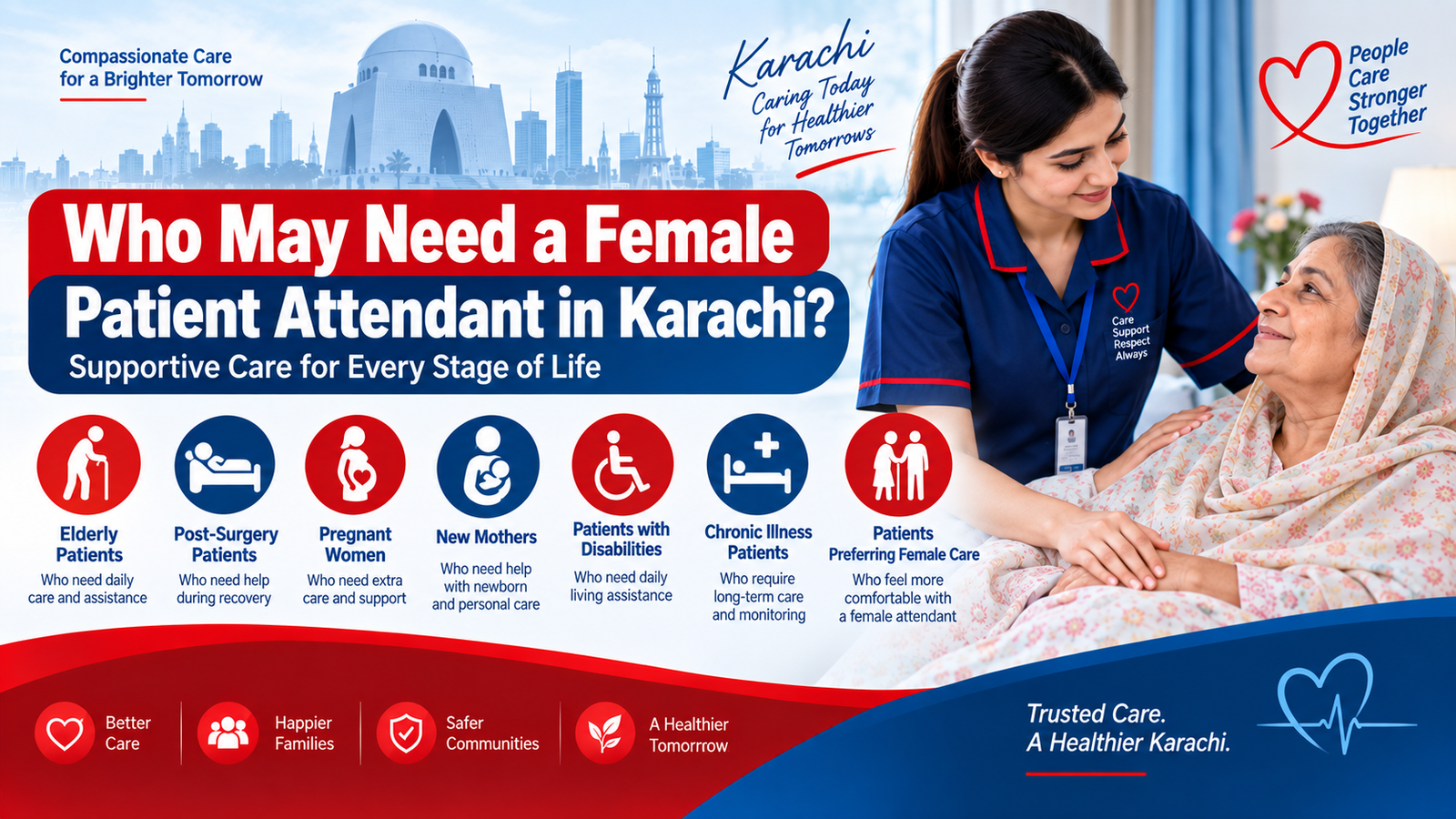
If someone is no longer able to carry out some of their day-to-day routines safely without help, a patient attendant might be helpful.
One group is older adults. The older person can be mentally sharp, but may require assistance with getting out of bed or walking to the bathroom, cooking or eating meals, as well as assistance with getting dressed or with their personal care.
There is also the possibility of temporary support for patients who have been operated on.
Weakness, restricted movement, or pain may make things more difficult for a while after the medical procedure.
In addition, families can think about hiring an attendant for a patient who is physically disabled, weak, has a long-term care need, or is not mobile.
The need for an attendant must be determined on the basis of the actual condition of the patient and not based on a patient’s age or diagnosis.
When Is a Female Patient Attendant Helpful?
An attendant to help the patient with daily care may be valuable if the patient’s primary requirement is care rather than medical expertise.
For instance, an older woman recovering at home after an inpatient hospital stay.
She might be able to breathe normally, but can’t walk without help. She might have family/work demands that make it difficult to provide constant supervision.
There is a female attendant who can help with moving, feeding, cleaning, and keeping company with the person, but the family members are still involved in key decisions.
Likewise, a post-surgical patient could require some assistance for a few days or weeks until they can move around.
The key difference between caregiving support and clinical care.
A skilled healthcare professional may be needed instead if the patient requires other skilled medical care, such as injections, wound care, catheter care, IV medication, monitoring of serious symptoms, or other medical skills.
Female Patient Attendant vs. Home Nurse
A patient attendant and a home nurse can both support patients at home, but their roles are different.
A patient attendant generally focuses on personal assistance and everyday care.
A nurse provides professional nursing care within their qualifications and scope of practice.
Factor | Female Patient Attendant | Home Nurse |
Main role | Daily personal and caregiving support | Professional nursing care |
Personal hygiene assistance | Usually part of caregiving support | May be provided when appropriate |
Mobility assistance | Common responsibility | May assist depending on patient needs |
Companionship | Common | May be provided but is not the primary role |
Clinical procedures | Generally outside the attendant’s role | May perform appropriate nursing procedures |
Medical assessment | Not a substitute for clinical assessment | Can provide nursing assessment within scope |
Best suited for | Patients needing routine daily assistance | Patients requiring skilled nursing care |
Some patients may need both types of support. For example, a patient with limited mobility may benefit from an attendant for daily activities while a nurse visits according to a prescribed or clinically appropriate care plan.
What Services Can a Female Patient Attendant Provide?
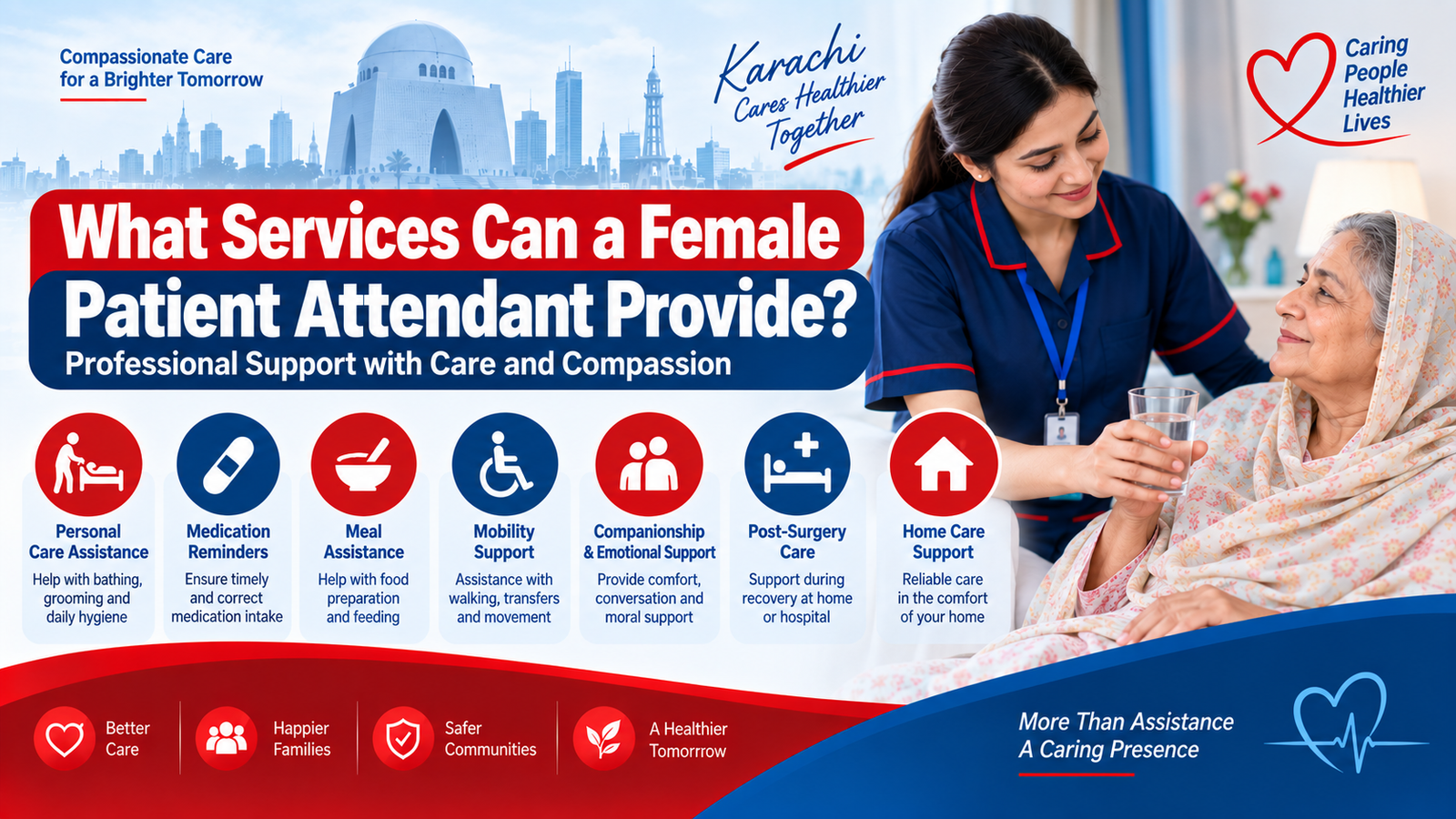
Services offered will vary by service provider and the needs of the patient. A home care provider like Intensive Patient Care can provide patient support based on the kind of help that is required, but families must verify what services, schedule, and skill level of the caregiver they will be receiving before they begin services.
Personal Care Assistance
Personal care may involve assistance with bathing, dressing, grooming, toileting or changing clothes.
This support may be particularly helpful for a person who finds it hard to clean up when unwell, weak or unable to move around due to age or illness.
The key principles of privacy and dignity must be maintained in respect of personal care.
Families should talk to the patient about their preferences before making arrangements with an attendant.
Additionally, the school will arrange for mobility and positioning support as needed.
Patients may require assistance when moving from a bed to a chair, in the bathroom, and in moving around the home if they have difficulty walking.
Patients who spend extended amounts of time in bed might also require frequent repositioning for comfort and to alleviate extended pressure on one part of the body.
If patients have a significant mobility issue, however, they should be dealt with carefully.
If specialized equipment and/or clinical knowledge is required to transfer the patient, it is important that this is done by a trained health care professional.
Food and drink help is available. Food and drink supports are provided.
Some patients may be able to feed themselves but require support to set up the meal, place it safely, and remind and support them to eat it.
An attendant may also support with regular fluids as required.
If a child has special diets, swallowing problems, a feeding tube or other medical nutritional needs, they should be provided in the manner recommended by medical professionals, not by informal instruction.
Companionship and Supervision
Patients might feel lonely while experiencing illness and after extended recovery. A familiar caregiver who is close by can offer conversation, reassurance, and overall companionship.
Supervision may also be helpful if the patient is at risk of falling or requires help with daily tasks.
But when the patient’s condition is unstable, the attendant should not replace emergency monitoring or constant medical supervision by a trained professional.
Benefits of Hiring a Female Patient Attendant
The primary advantage is that this offers practical support to a patient so that they can get help in the everyday activities of life without having to rely on all family members.
In addition, a female caregiver can be able to give extra comfort to patients who wish for a female for personal care. This may be applicable for assistance in bathing, dressing, grooming, and toileting.
Other benefits that might arise from this are:
- Smoother support of daily activities.Smoother support of daily activities.
- Easing the burden on family care providers
- Assistance with safe mobility
- Improved personal hygiene assistance
- Companionship during recovery
- More ease and better organization for family members that have to carry on with their work and their household duties.
Support offered to patients who require help with recovery at home following discharge.Support provided for patients requiring support at home following discharge.
These benefits are contingent on the patient’s condition, suitability of the caregiver, and the quality of the care provided.
Female Patient Attendant at Home in Karachi
Home-based patient care may be a convenient option for people who are stable and only require assistance with daily activities.
Karachi is a big, busy city, and families might be a long way away from the hospital, or they might have busy work schedules. In-home care may be an option for a patient to stay in their own home and get help with daily activities.
Families should think about the patient’s home environment before having a home attendant. Access to stairs, bathrooms, small areas, loose rugs, poor lighting, and hard beds can pose additional dangers to a person with limited mobility.
The house should be as safe as possible. Items that are regularly used should be readily accessible for the patient and carer, and the pathways should remain clear.
How to Choose a Female Patient Attendant in Karachi
The selection of the attendant should not be made just because someone is available. The caregiver should be suitable for the patient’s physical needs, daily routine, personality and level of help needed.
Inquire with the provider regarding the caregiver’s experience, duties, hours of work, and supervision.
It is also helpful if it is specified whether it is an hourly or shift service, overnight or live-in service. Families need to really know what they are subscribing to before the service starts.
Before getting a job with a company, consider the following questions:
Before selecting a female patient attendant, families can ask:
- What is meant by service?
- Has the attendant had any experience in caring for patients?
- Is the attendant able to help with moving around and washing?
- What time or shifts are available?
- Are overnight care or in-care facilities available if necessary?
- Who is to be contacted in the event of a problem in the family?
- If the attendant assigned is not available, what then happens?
- What are tasks the attendant is not responsible for?
- What is required instead of an attendant: a nurse?
- What happens when the patient’s condition changes; how is this communicated to the family?
Having the answers to these questions can help prevent any misunderstandings down the road.
Female Attendant for Elderly Patients
Older people may require help even if they don’t need hospital care. Difficulty with independence due to weakness, loss of balance, vision problems, arthritis, illness recovery, or performing everyday tasks can make living independently more difficult.
A female patient attendant can assist an older person to dress, bathe, walk, eat, keep company, and with everyday activities.
Older adults may still have medical issues that might necessitate the presence of medical nursing or doctor intervention in the family home, so it would be better to consider that issue too. The attendant is expected to be able to help, but cannot be expected to handle complicated medical issues.
Female Attendant for Patients After Surgery
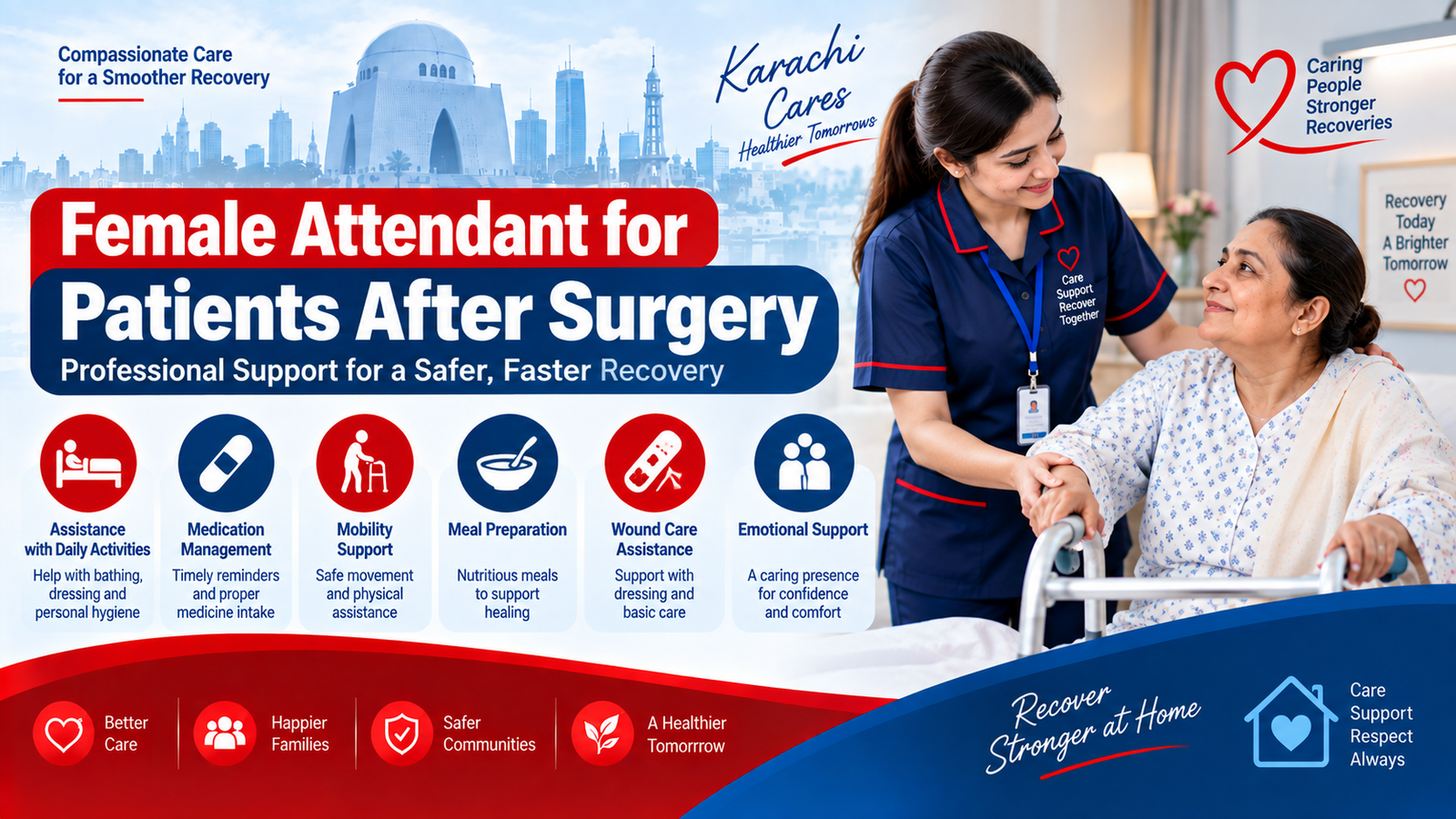
Sometimes recovery doesn’t stop after you leave the hospital. The individual may require temporary support to walk, bathe, dress, feed, and do chores.
Recovery can be supported by a female attendant who can assist with these non-clinical needs.
The patient should follow the surgeon’s or treating healthcare professional’s instructions for activity, wound care, medications, diet, and follow-ups, however. If the patient experiences an unusual or deteriorating symptom, the family should seek medical advice as appropriate, but not assume that the attendant will know what to do.
When Should You Hire a Nurse Instead?
A patient attendant may be needed for many activities of daily living (ADLs), however, some require skilled nursing or medical care.
Request assistance from a professional nurse if the patient requires clinical procedures, complicated wound care, insertion of a catheter, IV therapy, injection, medical monitoring or other nursing tasks.
If the patient has a serious warning sign like: severe breathing difficulty, chest pain, sudden loss of consciousness, signs of stroke, uncontrolled bleeding, severe confusion, or another worsening condition, seek urgent medical attention.
Depending on the medical condition, care levels are appropriate. If not sure, consult with the patient’s doctor or health care providers as to the needed support.
Common Mistakes Families Should Avoid
A frequent error is to hire an attendant who does not know what the patient requires. It is possible for a caregiver to provide companionship and personal help, but not be skilled in clinical procedures.
Another error is not describing the patient’s daily activities. Having clear instructions regarding meals, mobility, personal preferences, sleeping arrangements, and household safety can make care more organized.
It is important to note that families should not rely on an attendant to make diagnoses or medical decisions. Should a patient’s condition change, the family should contact the appropriate health care professional.
Last but not least, take the patient’s preference into account. When making a decision about a respectful care arrangement, it is important to take into account privacy, communication, cultural expectations, and comfort.
How Does Home Patient Care Usually Work?
Most frequently, this starts with an assessment of patient needs. The family/care provider determines the type of assistance, preferred schedule, location, and what the family/care provider expects of the individual assisting.
An appropriate carer is then selected based on the requirements agreed. Life at home should be explained to the family, including what should happen to the patient, any safety factors, etc., and any instructions received from health care professionals.
Arrangements for care can be temporary or permanent. A patient recovering from surgery may need assistance for a short time, or an elderly person with long-term mobility problems may need help on an ongoing basis.
The arrangement should be reviewed if there is a change in the patient’s condition or their independence.
How Much Care Does a Patient Need?
No one schedule fits all patients. A person who needs only help with bathing and meals will need fewer hours than another person who might need help to move around and supervision.
An appropriate schedule may vary according to:
- The patient’s mobility
- The ability to carry out personal care activities.
- Cognitive condition
- Daily routine
- Family availability
- Risk of falls
- Recovery stage
The child needs to be cared for overnight. The child requires night supervision.
Whether professional nursing care is also needed
The arrangement should be reviewed when the patient’s condition or level of independence changes.
Choosing Patient Care in Karachi: A Practical Approach
If you are in Karachi and are looking for a female patient attendant, pay attention to the patient’s needs rather than just the availability or price.
Find a provider who will communicate the role of the caregiver, the hours, communication, planned absences, coverage, and the separation of the care provider from the clinical team.
If the family is thinking about Intensive Patient Care, the ideal way is to talk about the requirements of the patient with the provider and agree on which caregiver or healthcare professional will be suitable.
A proper care arrangement should be able to make the patient feel cared for, keep the family members informed, and provide medical care to the patient by qualified professionals.