


What Is Home Nursing Care?
Home nursing care is the provision of qualified nursing care provided to a patient in their home. Care could involve checking vital signs, assisting with wound care, helping to manage prescribed treatments, facilitating recovery, and watching for changes in health status, depending on the patient’s health condition and the scope of professional practice of the nurse.
Home nursing is not the same as housekeeping. A nurse can complete clinical activities that are best suited to their training and authorization, and a caregiver can support the person with their daily activities, such as bathing, dressing, and eating.
The care plan should be tailored to the patient’s medical needs and not be the same for all patients.
For instance, someone recovering from surgery may require wound observation and support with mobility; someone who is older and suffering from a chronic condition may require regular monitoring and assistance to follow a clinician’s instructions.
Families need to verify in Karachi the services offered, the qualifications of the nursing staff, and whether the service can provide the patients’ particular needs.
Who Needs Home Nursing Care in Karachi?
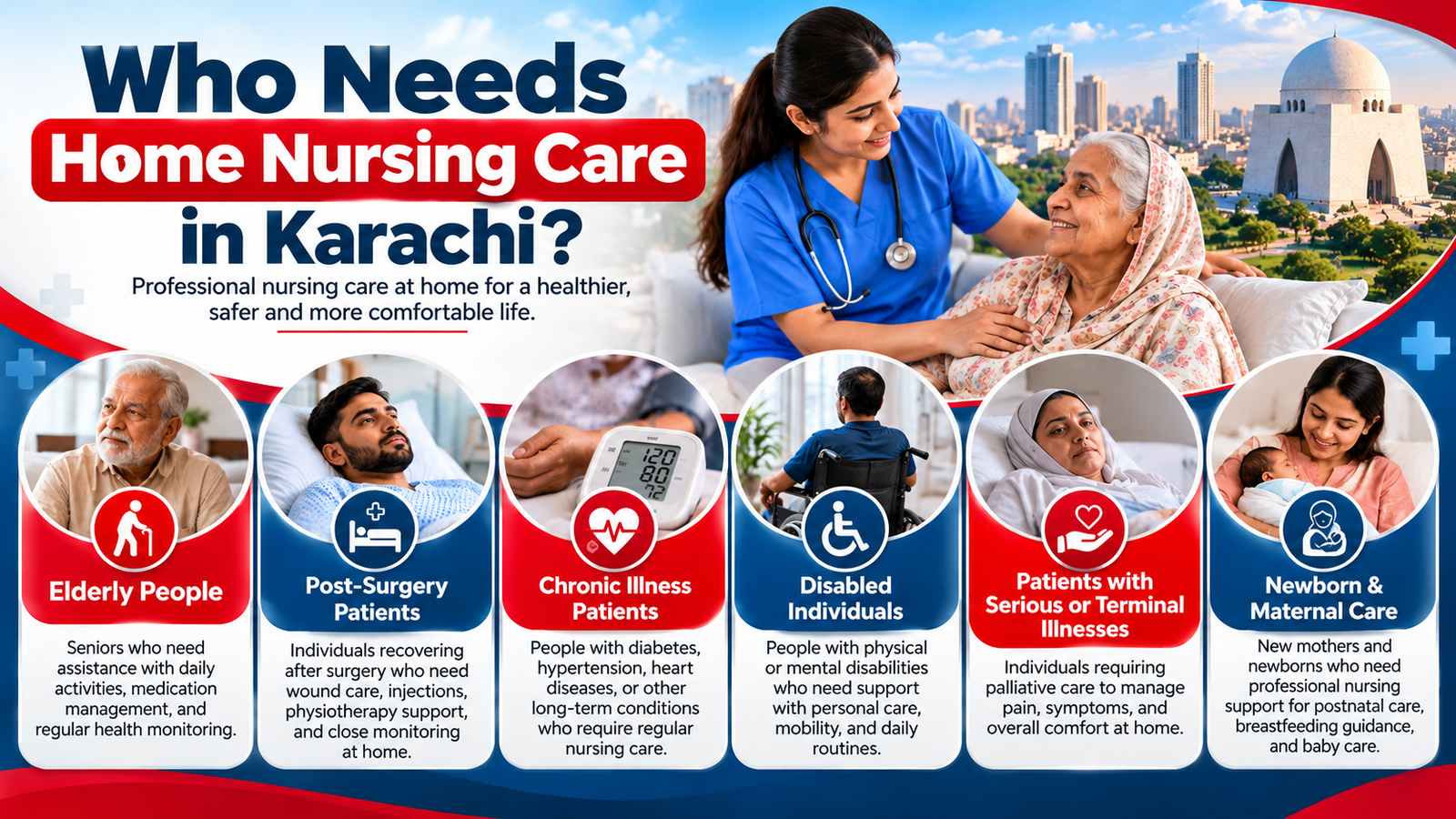
Some patients might require professional support but can be cared for at home, and home nursing would be appropriate for them. Only a doctor or qualified health care worker can decide if home-based care is suitable.
Patients who have recovered following surgery
Patients who have recovered from surgery: Nursing care after procedures like abdominal surgery, orthopedic surgery, or other surgeries may be required.
A nurse could manage the healing process, watch for surgical site changes, assist with rehabilitation, and note changes that may need medical attention based on the discharge plan.
Families must comply with the surgeon’s instructions regarding movement, dressing, medication, and follow-up visits. A nurse should not perform a surgical procedure without the surgeon’s authorization or alter the treatment plan.
People who are older adults and require ongoing support.
Elderly individuals may have limited mobility, weakness, balance problems, or problems with multiple health conditions. Clinical support can be given at home as per their needs.
For some older people, this means the occasional visit by a nurse; for others, it may be more frequent supervision.
How they are arranged will vary according to their health, ability to carry out activities, safety at home, and the support they have within their families.
Patients Living With Chronic Conditions.
Individuals with a chronic condition (e.g., diabetes, heart disease) might require support with implementing a care plan. Persons who have a chronic condition (e.g., diabetes, heart disease) may require assistance to adhere to a care plan.
Nursing care can involve checking certain health parameters, watching for signs and symptoms, and repeating the teaching of the healthcare provider.
Home nursing doesn’t remove the need for medical appointments or laboratory tests or specialist consultations. Regular contact with the patient’s doctor should be kept up with by families.
Patients with limited mobility.
If your patient is struggling to walk, turn, or get about around the house, they may require extra assistance. Nursing care may also involve monitoring skin condition, providing care related to skin care, and being able to coordinate safe movement as recommended by the professional.
Families should enquire with the care provider about how they will assess and manage fall risk and pressure risk in patients who are likely to fall or develop a pressure injury.
Patients in need of palliative care support.
Care for those with serious or life-limiting diseases may require assistance with comfort, symptom monitoring, and personal care. If appropriate services are available, home nursing can be part of a holistic palliative care program.
Talk with the patient’s health care providers about pain management, symptom changes, emotional support, and emergency plans with the family. Some home nursing agencies do not provide specialist palliative care services—check the availability of this service.
What Services Can Home Nursing Include?
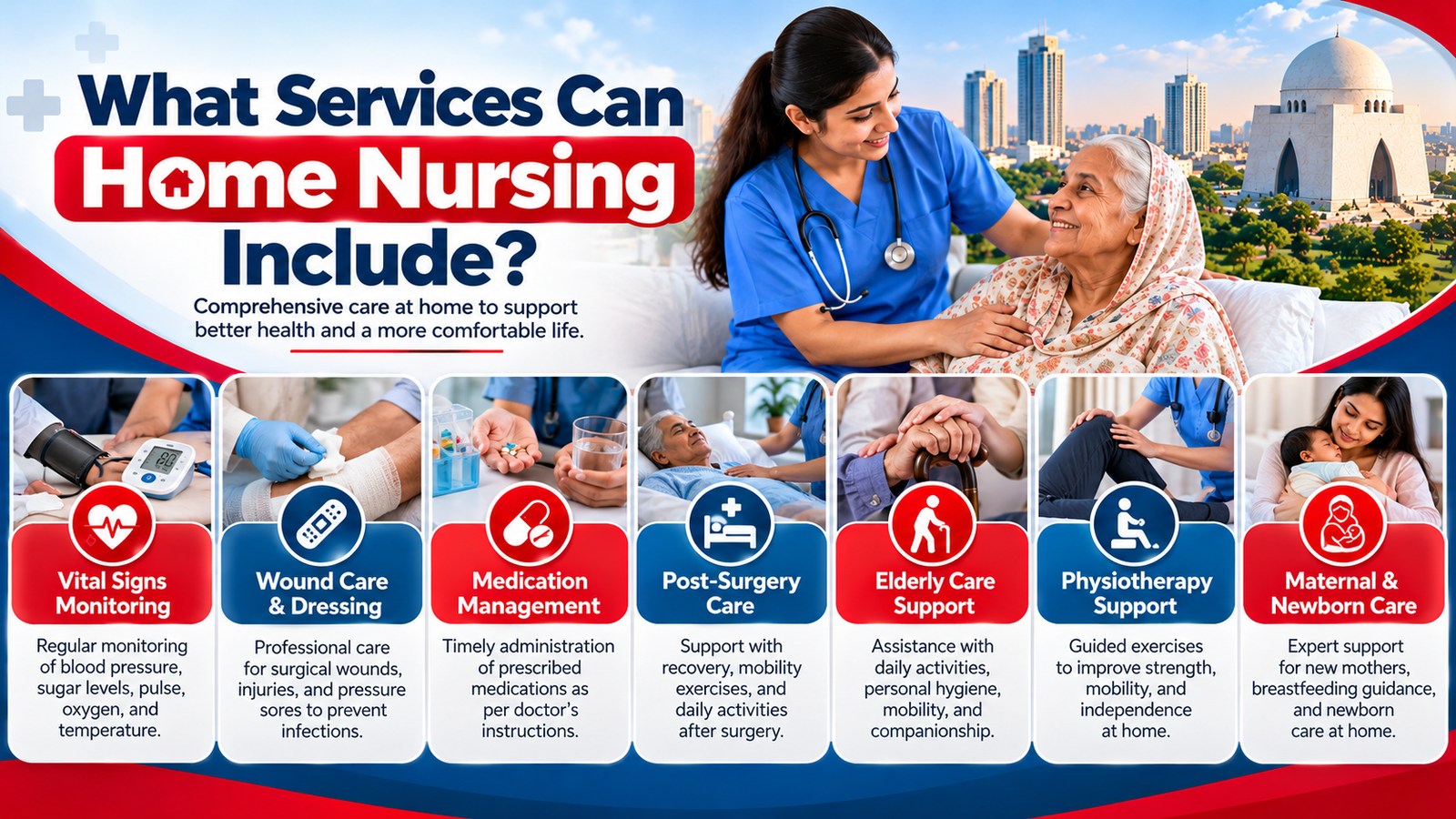
The services provided at home are dependent on the condition of the patient, the type of nursing home and the skills of the nurses. If you are arranging for someone to care for someone who has a medical need, make sure you request a thorough explanation of what is included in their care and what they need extra medical supervision for.
Basic Nursing Assessment and Monitoring
A nurse can take vital signs and check the patient’s status if clinically appropriate (e.g., blood pressure, pulse, temperature, or oxygen saturation). The observations can assist the healthcare team to track changes in the patient’s condition.
Monitoring is not enough to make a diagnosis. The nurse should adhere to the agreed plan of escalation if the reading is abnormal or if new symptoms occur.
Treatment for wounds and surgeries.
Some patients may require assistance with their wounds, dressings, or any other prescribed wound care. The nurse can administer care within their scope of practice and adhere to the treatment plan given by the treating clinician.
Families should inquire of the provider how they ensure hygiene, how they record changes and how they react to signs of infection. If redness, swelling, increasing pain, unusual discharge, and/or fever occur, immediate medical evaluation may be necessary.
Medication Support
Patients might not be able to remember to take their medication or adhere to a complicated treatment plan. Nursing support can vary from the management of medications to help with the prescribed nursing schedule.
Medication must only be given on prescription and in line with professional requirements. When a nurse makes a change in medication doses, stops a medication, or suggests a new medication, families should not request these interventions without the proper authorization.
Support for personal care and mobility skills.Personal care and mobility assistance.
Personal Care and Mobility Assistance.
Others require assistance with bathing, dressing, feeding, positioning, or ambulation (walking) within the home. The activities can be offered by a nurse or a trained caregiver, depending on the patient’s needs and the providers’ service model.
Specify who is going to do what. There is no one-to-one correspondence between clinical care and non-clinical care tasks.
Insert a catheter and perform other clinical care.
Some patients will need assistance with the catheter, feeding tube, or other medical equipment. The tasks must be trained, clinically authorized, and must employ proper infection prevention practices.
Not all nurses or home care providers will provide all procedures. When arranging specialized care for a family, they should check that staff are competent, equipment is in place, and the instructions given by the treating doctor are correct.
How Does Home Nursing Care Work?
Typically, the screening starts with a review of the patient’s health, daily living, and home needs. The provider should collect the necessary information prior to the recommendation of what care and how many times should be provided.
Step 1: Discuss the Patient’s Needs.
Describe the patient’s diagnosis, recent hospitalization, mobility, any treatments prescribed, and concerns. Provide written discharge information and discharge plan if available.
Indicate whether or not the patient requires clinical nursing, personal care, overnight supervision, or a combination of services. Some of these requirements may impact what professional type should be employed to assist.
Step 2: Validate Care Plan
The provider should make clear what should be done, how often they will be on site, who will be on site, and what needs medical review. The care plan should follow the guidelines of the patient’s treating clinician.
Discuss with them what they will do to monitor progress and how the family will be updated. With a well-defined plan, there is no room for confusion on the part of the services being provided.
Step 3: Set up the Home.
Ensure the patient’s room is safe, clean, and accessible. Make sure to have necessary supplies, necessary medications, discharge paperwork, and contact information available as needed.
If the patient is using medical equipment, ensure that it is appropriate for home use, and the appropriate personnel are able to explain how it needs to be used.
Step 4: Review Care Regularly
A patient’s requirements may alter as they recover, or as the illness develops. The care arrangement should be reviewed if mobility improves, symptoms change, a new treatment is prescribed, or more support is needed.
Families should be aware of who to contact if the nurse is not able to attend, the patient’s condition worsens, or the care plan doesn’t suit the patient’s needs.
Benefits of Home Nursing Care
Sometimes practical benefits are obtained in home nursing when the patient’s condition can be safely handled at home. The benefits vary depending on the quality of care, the kind of care needed, and the support provided by family members.
One benefit would be the patient can get the right nursing care without having to move to each and every normal nursing task. This will be helpful for individuals who have reduced mobility or are recovering from an operation.
A familiar environment at home can also help to make daily routines easier. Family members are able to join in on care discussions, understand how to follow the professional instructions, and be updated on the patient’s progress.
Having a nurse at home can make it easier for families to plan care, have clear care plans and responsibilities. It can also play a role in ensuring continuity from the discharge to the follow-up appointment.
Home nursing cannot, however, ensure speedier recovery or the absence of all complications. Patients requiring urgent treatment, sophisticated hospital monitoring, or specialist intervention should be treated at an appropriate medical centre.
Home Nursing Care vs. Hospital Care
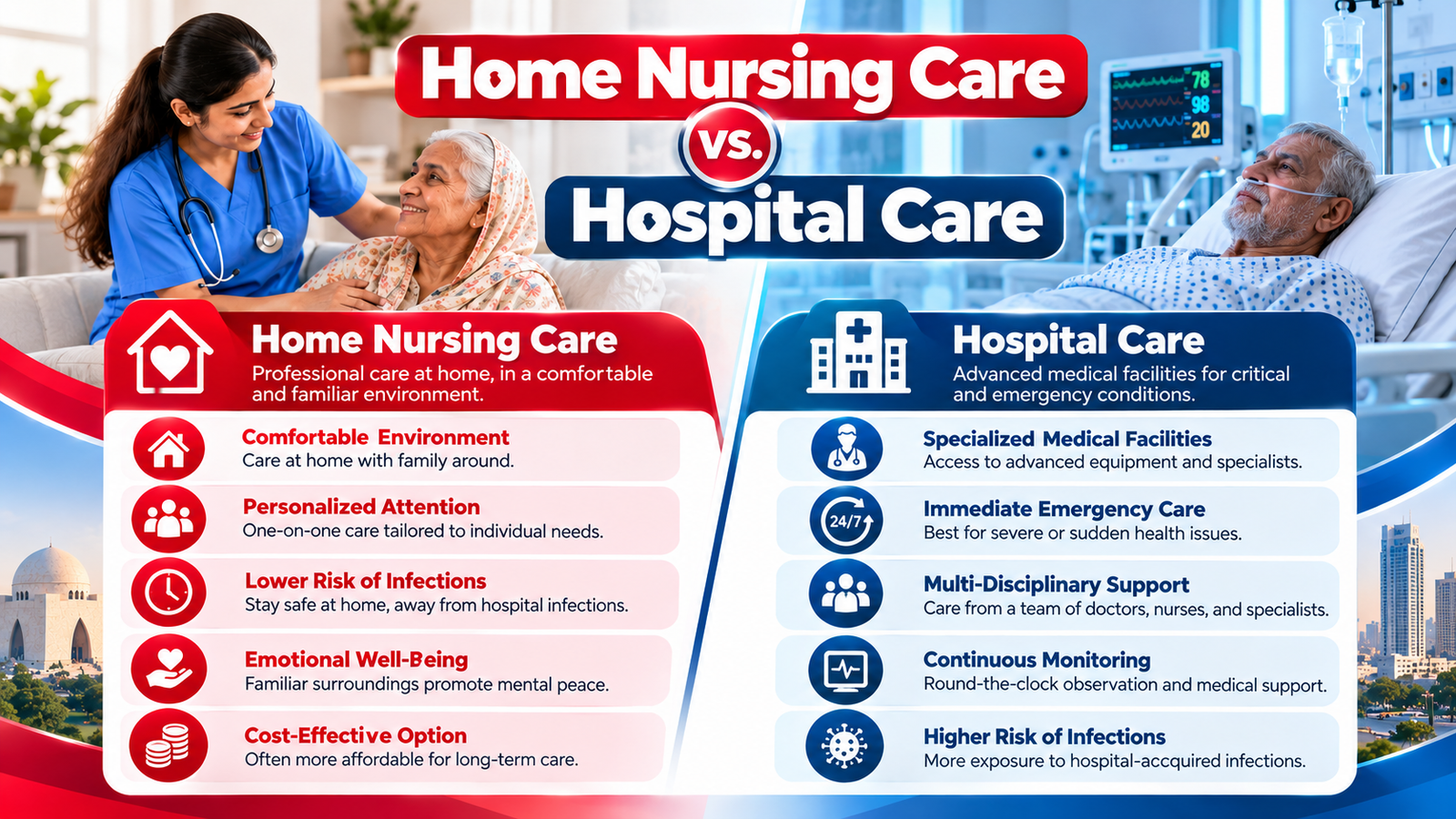
Choosing between home nursing and hospital care depends primarily on the patient’s condition and the level of medical supervision required.
Factor | Home Nursing Care | Hospital Care |
Main setting | Patient’s residence | Medical facility |
Suitable needs | Selected nursing tasks and recovery support | Conditions requiring hospital assessment or treatment |
Medical resources | Depends on available staff and home equipment | Access to hospital facilities and clinical teams |
Family involvement | Often more direct daily involvement | Depends on hospital arrangements |
Emergency response | Requires a clear plan to obtain urgent help | On-site emergency services may be available |
Best choice | When home care is clinically appropriate | When hospital-level assessment or treatment is necessary |
Neither option is automatically better for every patient. A person recovering from a procedure may be able to return home with a suitable care plan, while someone experiencing severe breathing difficulty or another medical emergency needs urgent medical assessment.
The treating healthcare professional should help determine the safest setting.
How to Choose a Home Nursing Provider in Karachi
Choosing a provider isn’t just about availability or price; it’s about finding the right fit. Families should check qualifications and ensure that the provider is working within its scope of practice and is able to provide the required care.
Check Nursing Qualifications
Inquire about a nurse’s qualifications, current license or registration (if applicable), clinical experience, and clinical training for the tasks needed for the patient.
Other skills may be required for specialized procedures. Not all caregivers are capable of clinical nursing care.
Confirm the Services and Schedule.
Inquire about the possibility of longer visits, overnight care, and/or extended hours. Availability is subject to change; check directly rather than through general advertising.
The provider should include information about the services that are provided and those that are not, and what the family will need to arrange, as well as what will happen if staff are replaced or cannot go to the setting.
Know your costs before you begin.
The price of home nursing will depend on the length of time the nurse is staying at the home, the skills and training of the nurse, the patient’s condition, what she must do for the patient and the frequency of visits.
Ask to receive a written proposal detailing the costs, terms of payment, extra costs, and cancellation policy. Don’t assume that the one advertised rate applies to all nursing needs.
Ask About Hygiene and Patient Safety
Know how staff dispose of hand hygiene, protective equipment, clinical waste, and infection prevention. Discuss with the patient what to do if the patient gets a fever, the wound changes, or if the measurement goes outside of the pre-arranged limits.
Providers should have a clear process for documenting concerns and escalating concerns to the appropriate clinician.
Set up Communication and Emergency Plans
The family should know who the nurse staff member is that is supervising the nurses, how they get their updates of care, and who they should contact if they want to know more outside of set times.
Inquire if the provider has an emergency plan in place. Home nursing should never be offered as a replacement for emergency medical service.
Important Questions to Ask Before Booking
Before choosing a home nursing service, consider the following issues with the provider:
- Who is going to care for them, and what do they qualify in?
- Have they had training in the care of this patient’s particular needs?
- What are the agreed services for nursing?
- What is the charge, shift timing, and payment terms?
- What is the method of communication of Care Records and changes in patient condition?
- What do you do if the nurse you received your assignment to is not available?
- What will happen to the pressing symptoms or other emergencies?
Written responses can assist the family in comparison shopping and making informed decisions. Have the patient’s medical records, medication list, allergies, and emergency contacts available to healthcare providers.
When Is Home Nursing Not Enough?
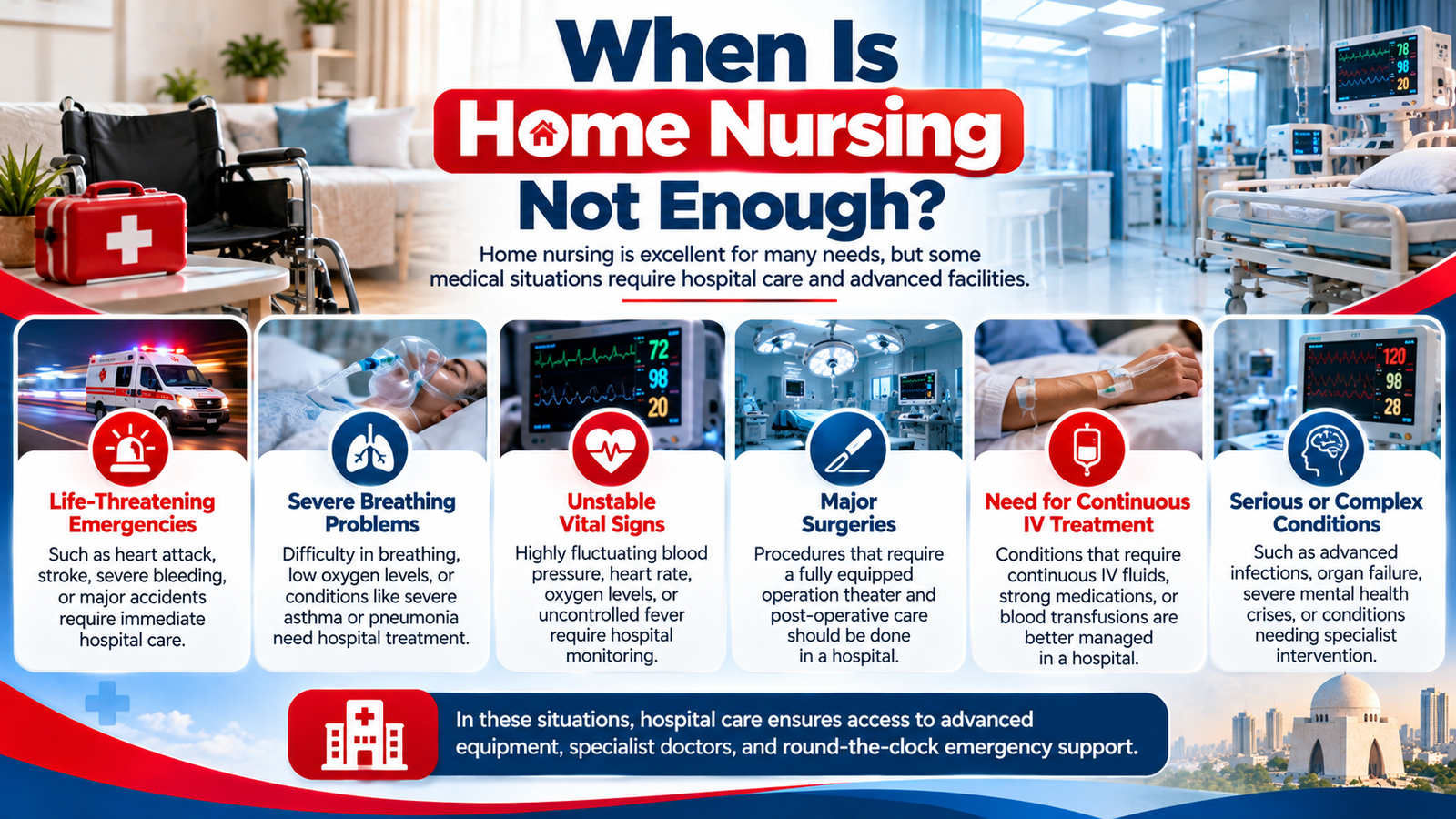
Only home nursing is indicated when the patient can be cared for safely at home. Certain conditions will not need a planned visit to the nursing home, but may need urgent evaluation or hospitalisation.
If the patient has a sudden onset of severe difficulty breathing, chest pain, loss of consciousness, new onset of stroke, excessive bleeding or other potentially life-threatening symptoms, seek emergency medical help.
Never delay a patient’s next home nursing visit when the patient’s condition is rapidly declining. Follow local emergency response procedure and instructions of the clinician.
Other alterations, such as persistent fever, worsening symptoms of wounds, new confusion, repeated vomiting, or a dramatic change in the level of awakefulness should also be assessed by the health care professional promptly. The urgency will depend on the patient’s condition and the severity of the symptoms.
Families need to be given clear guidance on who to call for urgent but non-emergency concerns, and when to go to a hospital.
Home Nursing Care in Karachi: Planning for Different Patient Needs
Karachi is a big city, and the practicalities of home care may be different depending on the area, distance travelled, staffing levels, and time of visits. Families should ensure that the provider can provide their location and can keep to the agreed schedule.
Write a detailed explanation of the patient’s needs prior to the first visit. Someone needing assistance following surgery could have unique needs to an older person who is needing help to carry on doing daily tasks or a patient who needs special nursing methods.
Early planning for appropriate support if the patient is being discharged from hospital. Seek advice on what can be done at home, any equipment that might be required, and any follow-up appointments to be made for the discharge team.
Once a family has considered services offered in Intensive Patient Care, they have the right to seek clarification about specific home nursing options, whether qualified staff are available to support the patient, and how the home nursing service will coordinate with the treating health care professional.
The services to be provided, staffing, and fees should be confirmed prior to booking.