
12 Hour Nursing Care is an extended home nursing service in which a trained nurse or appropriately qualified caregiver supports a patient for a continuous 12-hour shift, usually during the day or night.
Depending on the patient’s condition and care plan, support may include monitoring, medication assistance, mobility help, hygiene care, feeding support, and coordination with family members and doctors.
For families in Karachi, this type of care can provide a middle ground between short nursing visits and continuous 24-hour home nursing.
It may be useful when a patient needs regular supervision for much of the day or throughout the night but does not necessarily require round-the-clock nursing.
The right level of home care depends on the patient’s diagnosis, functional ability, medical needs, safety risks, and doctor’s recommendations.
This guide explains how 12-hour nursing works, who may need it, what services can be included, how it differs from 24-hour care, and what families should consider before arranging a nurse at home.
What Is 12 Hour Nursing Care?
12 Hour Nursing Care means providing organized nursing or patient-care support for a continuous 12-hour period.
The shift may cover daytime or nighttime hours and should be planned according to the patient’s clinical needs, daily routine, mobility, medications, nutrition, personal care requirements, and level of supervision.
Unlike a brief home nursing visit, a 12-hour shift gives the care professional time to observe the patient across a substantial part of the day or night.
For example, an older adult recovering after hospitalization may be able to remain at home but still need help with safe movement, scheduled medicines, meals, hygiene, and observation.
A longer shift can provide continuity instead of relying on several short visits.
The actual duties should always match the qualifications of the person providing care.
Tasks that require nursing skills should be performed by an appropriately trained healthcare professional rather than an unqualified attendant.
Who May Need 12 Hour Nursing Care at Home?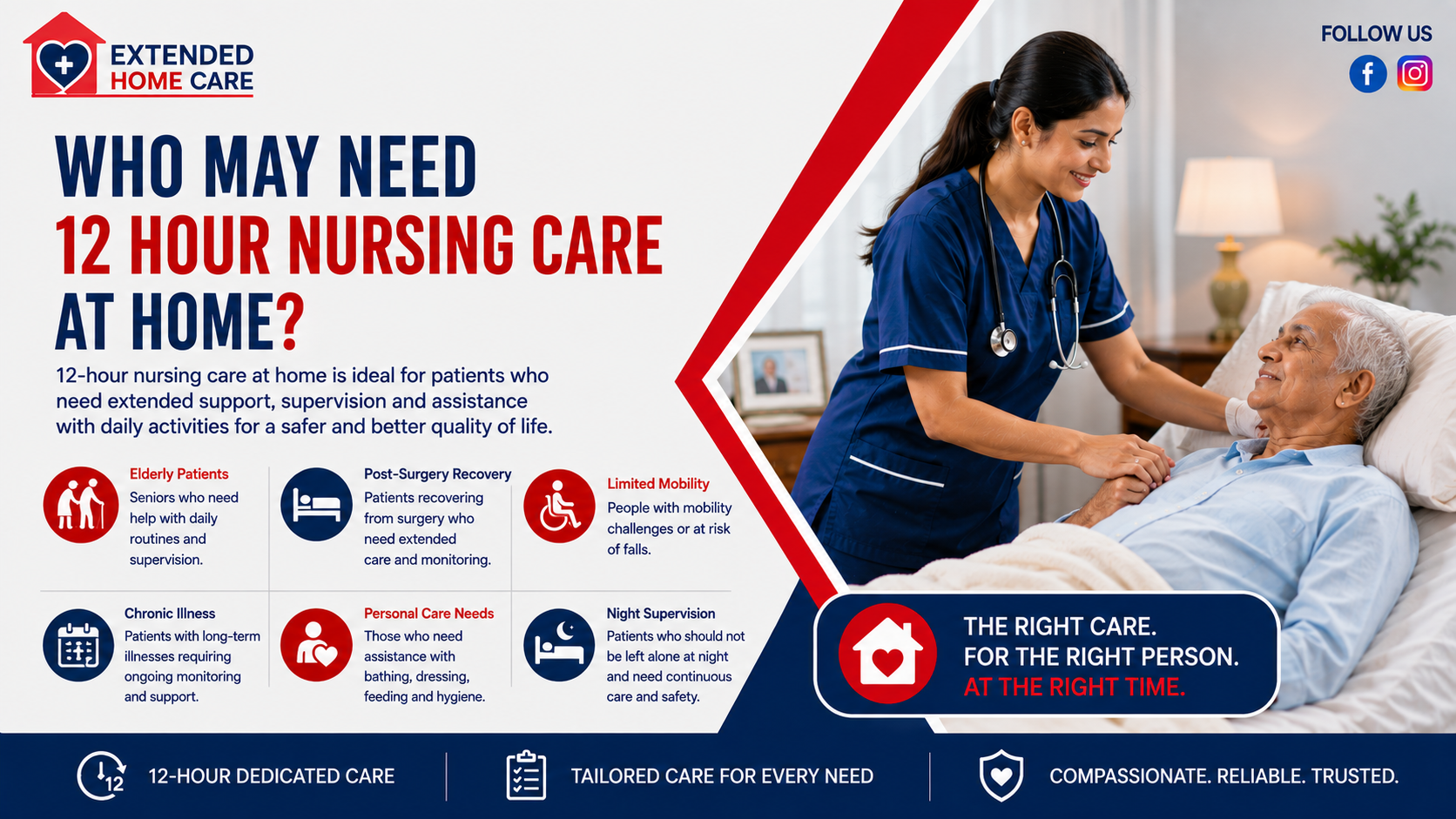
Extended nursing care may be considered when a patient is medically stable enough to remain at home but requires prolonged supervision, nursing support, or assistance with daily activities.
The decision should be based on the patient’s condition rather than convenience alone.
A 12-hour arrangement may be considered for older adults who cannot safely manage their daily routine independently.
It can also be useful during recovery after surgery, hospitalization, serious illness, or a period of reduced mobility.
Patients living with chronic illnesses may sometimes require extended assistance when their condition affects movement, personal care, feeding, medication routines, or their ability to recognize and respond to changes in their health.
Common situations in which families may discuss extended home care include:
- Recovery after hospitalization or surgery
- Elderly patients requiring regular supervision
- Limited mobility or increased fall risk
- Patients requiring assistance with hygiene, feeding, or repositioning
- Long-term illness requiring an organized care routine
- Patients needing scheduled monitoring or nursing procedures
- Nighttime supervision for patients who should not remain alone
Not every patient in these situations needs a 12-hour nurse. A healthcare professional can help determine whether shorter visits, extended shifts, 24-hour nursing, rehabilitation, or another care model is more appropriate.
What Does a 12-Hour Home Nurse Do?
A 12-hour home nurse provides care according to an individualized plan and within their professional scope of practice.
Responsibilities can range from basic monitoring and assistance with daily activities to skilled nursing procedures when clinically required and appropriately authorized.
The shift often begins with reviewing the patient’s current condition, care instructions, medications, and any changes reported by the family or previous caregiver.
During the shift, the nurse may observe temperature, pulse, blood pressure, oxygen saturation, or other parameters when these measurements are part of the care plan.
Changes that require medical attention should be documented and communicated appropriately.
Medication support may also be included. This should follow the patient’s prescribed medication plan; home nursing is not a substitute for a doctor’s diagnosis or prescribing decisions.
Depending on the patient’s needs and the nurse’s training, care may also involve wound care, catheter-related care, feeding support, repositioning, mobility assistance, personal hygiene, and other prescribed nursing procedures.
Day Shift vs Night Shift Nursing Care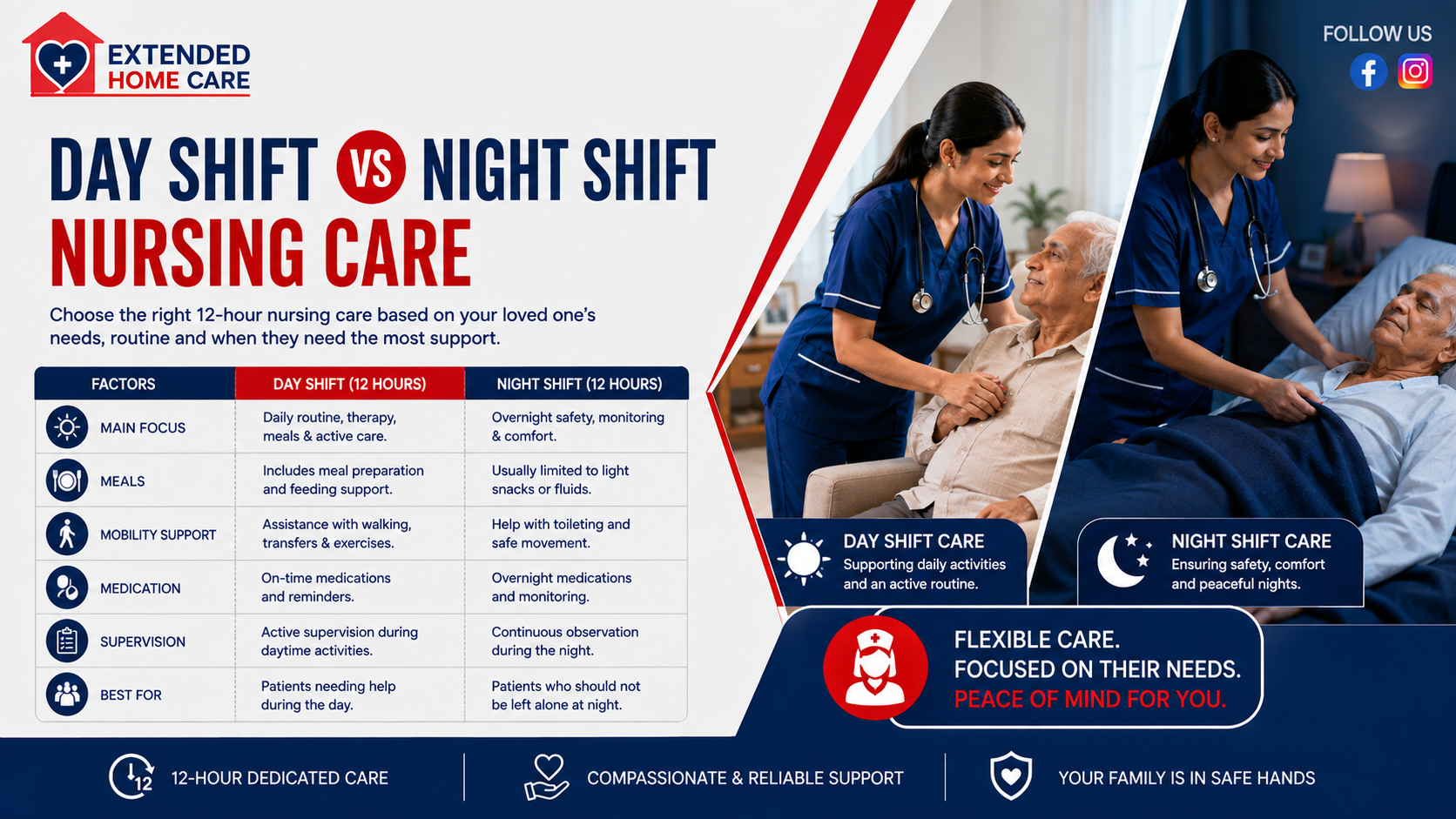
Families may choose daytime or nighttime coverage depending on when the patient needs the greatest amount of assistance.
|
Factor |
12-Hour Day Care |
12-Hour Night Care |
|
Main focus |
Daily routine and active care |
Overnight observation and safety |
|
Meals |
Often includes feeding or meal assistance |
Usually more limited |
|
Mobility |
Transfers, walking and daytime activities may require support |
Toileting and safe nighttime movement may be priorities |
|
Medication |
Supports medicines scheduled during the shift |
Useful when medicines or monitoring are required overnight |
|
Family benefit |
Covers working hours or daytime responsibilities |
Allows family caregivers to rest |
|
Best suited for |
Patients needing substantial daytime support |
Patients who should not remain unsupervised overnight |
The choice should follow the patient’s routine and clinical requirements. Some people need significant assistance during the day but sleep safely through most of the night.
Others may require closer nighttime observation because of confusion, mobility problems, toileting needs, or prescribed monitoring.
12 Hour Nursing Care vs 24 Hour Nursing Care
The main difference is continuity of coverage. A 12-hour service covers one extended shift, while 24-hour care provides support throughout the entire day and night, generally through organized shifts.
Patients who cannot safely remain without assistance outside a 12-hour shift may require continuous care instead.
Twelve-hour care can work when family members can safely manage the remaining hours or when the patient’s need for professional assistance is concentrated during a particular part of the day.
Twenty-four-hour nursing may be more appropriate when significant care requirements continue around the clock.
This can include patients requiring frequent clinical observation, complex nursing procedures, or continuous assistance that family members cannot safely provide.
Families should avoid choosing fewer hours solely to reduce cost if doing so would leave the patient without necessary support.
What Are the Benefits of Extended Nursing at Home?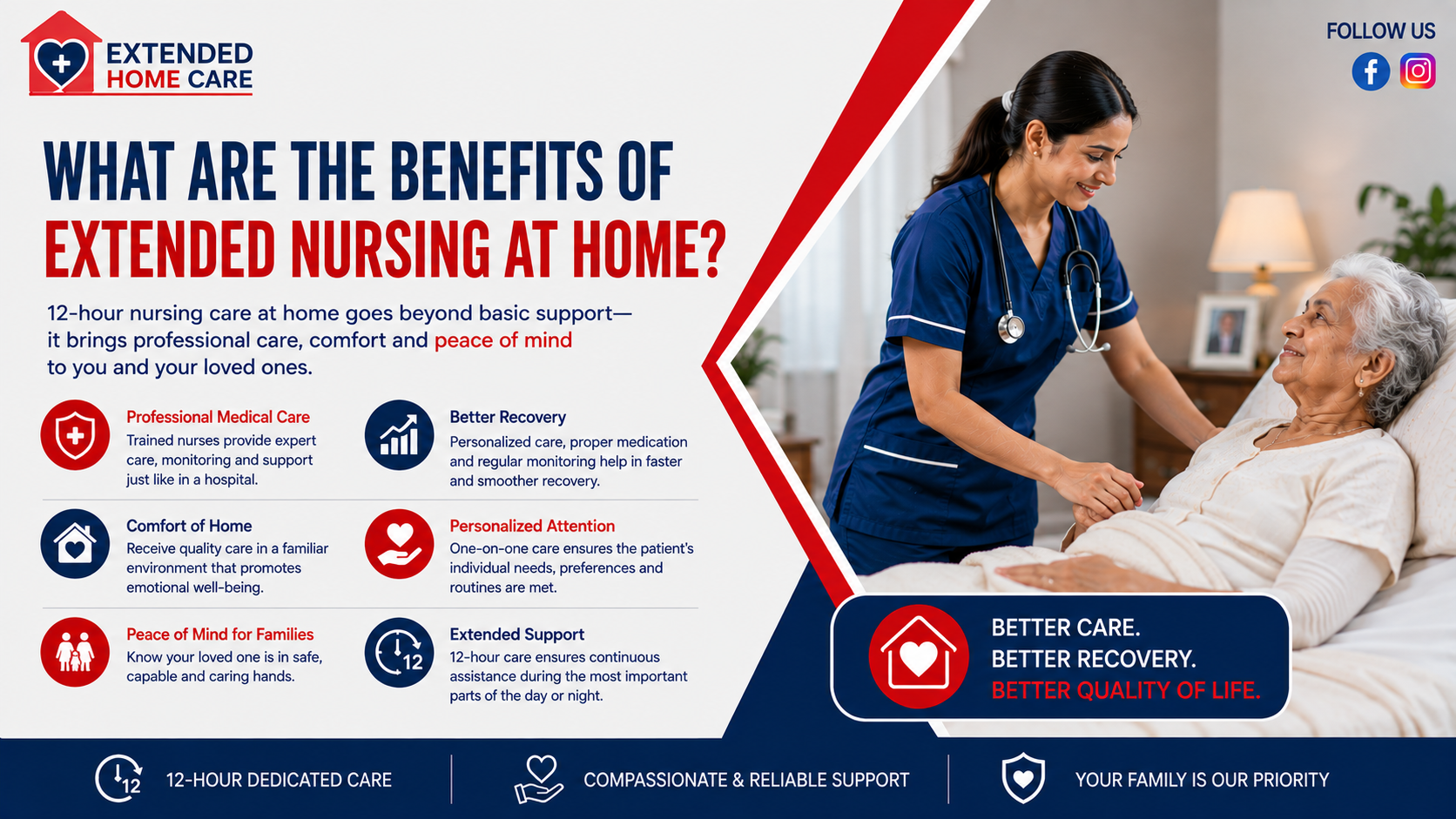
One major advantage is continuity. A nurse who remains with the patient for an extended shift can observe changes over several hours instead of seeing only a brief snapshot during a short visit.
Home care may also allow medically appropriate patients to receive support in familiar surroundings.
Being at home can make routines involving meals, sleep, family interaction, and personal belongings easier to maintain.
Extended nursing can also reduce the amount of direct caregiving that falls on family members.
Relatives can remain involved in decisions and emotional support without necessarily performing every physical or nursing task themselves.
However, home nursing does not replace hospital care when a patient is medically unstable or needs interventions that cannot safely be delivered at home.
What Patient Monitoring May Be Provided?
Monitoring depends entirely on the patient’s condition and medical instructions.
For some patients, basic observation may be enough. Others may have a care plan requiring regular measurement of vital signs or closer observation for changes in symptoms.
A home nurse may be asked to record relevant observations during the shift and communicate significant changes to the family or treating healthcare professional.
Accurate documentation can also make shift handovers more useful when several caregivers are involved.
Monitoring should have a purpose. Families should understand what needs to be checked, how frequently it has been recommended, and what changes require escalation.
Can 12-Hour Nursing Help After Hospital Discharge?
Yes, some patients can benefit from temporary extended nursing after discharge when they are stable enough to recover at home but still require assistance, observation, or prescribed nursing care.
The hospital or treating doctor should provide clear discharge instructions so home care follows the patient’s medical plan.
The transition from hospital to home can be demanding, particularly after major surgery or a serious illness.
A patient may still be weak, have difficulty walking, need wound care, or require help following a medication schedule.
A home nurse can help maintain an organized routine while the patient recovers. The level of support can later be reviewed as independence improves.
Discharge from hospital, however, does not automatically mean every aspect of treatment can be managed at home.
Families should understand follow-up appointments, warning signs, medication instructions, dietary recommendations, and any limitations on activity.
Nursing Care for Elderly Patients
Older adults are a common group requiring extended home support, but age by itself does not determine how many hours of care someone needs.
One elderly person may need only occasional assistance, while another may require substantial support with transfers, toileting, bathing, meals, medication routines, and safety throughout the day.
The home environment also matters. Stairs, slippery floors, poor lighting, inaccessible bathrooms, or a bed that makes transfers difficult can increase the practical challenges of home care.
Families arranging elderly nursing care in Karachi should therefore evaluate both the patient’s health and the environment in which care will be provided.
Is a Nurse the Same as a Patient Attendant or Caregiver?
No. Nurses, attendants, and caregivers may perform different roles, and their responsibilities should not be treated as interchangeable.
A qualified nurse can provide appropriate clinical nursing care, while an attendant or caregiver may primarily assist with personal care, mobility, companionship, feeding, and everyday activities.
The distinction becomes especially important when a patient needs skilled procedures.
If the main requirement is companionship, bathing assistance, meal support, or help moving around the home, an appropriately trained caregiver may meet some patients’ needs.
If wound management, clinical assessment, catheter care, prescribed injections, or other skilled procedures are required, families should confirm that the professional has the necessary nursing qualifications and competencies.
Matching the caregiver’s skill level to the patient’s needs can improve both safety and value.
How Should Families Choose a 12-Hour Nursing Care Provider in Karachi?
Choose a home nursing provider by comparing the patient’s actual care requirements with the qualifications, supervision, reliability, and service arrangements offered by the provider.
Families should ask who will deliver the care, what tasks are included, how emergencies are handled, and how replacement staff are arranged.
Before starting the service, prepare a clear summary of the patient’s condition and requirements.
This can include prescribed medicines, mobility limitations, diet, allergies, nursing procedures, doctor instructions, and important contact information.
When evaluating a provider, consider:
- Whether a nurse or caregiver is appropriate for the patient’s needs
- Relevant qualifications and identity verification
- Experience with the type of care required
- Clear definition of duties during the 12-hour shift
- Shift timing, handover procedures, and staff replacement arrangements
- Communication with family members
- Documentation of nursing observations when needed
- Emergency escalation procedures
- Transparent charges and what the quoted fee includes
Families considering Intensive Patient Care for 12 Hour Nursing Care in Karachi can use the same checklist before arranging services. The patient’s clinical requirements should determine the type and level of professional assigned.
What Should Be Prepared Before the Nurse Arrives?
A little preparation can make the first shift more efficient.
Keep current prescriptions, discharge documents, medication lists, relevant medical reports, and the treating doctor’s instructions accessible.
The nurse should also know about allergies and any specific restrictions.
Necessary care supplies should be available when possible. The exact items depend on the patient and may include monitoring equipment, wound-care supplies, hygiene products, mobility aids, or other doctor-recommended materials.
Families should also establish who should be contacted if the patient’s condition changes.
How Much Does 12 Hour Nursing Care Cost in Karachi?
The cost of 12 Hour Nursing Care in Karachi can vary according to the professional’s qualifications, patient complexity, shift timing, required procedures, duration of service, and provider.
A patient needing skilled nursing procedures may have different care requirements and costs from someone primarily needing supervision and daily-living assistance.
Rather than comparing prices alone, families should compare what each service actually includes.
Ask whether the quotation is for a qualified nurse, nursing assistant, or caregiver; whether nursing procedures carry additional charges; and whether transportation, supplies, or holiday shifts affect the final cost.
A written explanation of services and charges can prevent misunderstandings later.
When Is Home Nursing Not Enough?
Home nursing has limits. A patient experiencing a medical emergency should not remain at home simply because nursing support is present.
Seek urgent medical help for serious warning signs such as severe difficulty breathing, new severe chest pain, sudden loss of consciousness, uncontrolled bleeding, seizures, or sudden symptoms suggestive of stroke, such as facial drooping, arm weakness, or difficulty speaking.
Other significant or rapidly worsening symptoms also require prompt medical assessment.
A home nurse can recognize and report concerning changes, but emergency hospital care provides diagnostic tests, medical teams, and interventions that cannot always be replicated in a home setting.
Frequently Asked Questions
Is 12 Hour Nursing Care available for both day and night shifts?
Yes. Extended care can generally be organized as a daytime or nighttime shift depending on the patient’s needs and the provider’s staffing arrangements.
Can an elderly patient receive 12-hour nursing at home?
Yes, when extended assistance is appropriate. The required level of care depends on mobility, medical needs, daily activities, cognitive function, and safety risks.
Is 12-hour nursing enough after surgery?
It may be for some medically stable patients, but others need shorter visits or continuous care. The surgeon or treating team should guide post-operative care requirements.
Can a home nurse give medicines?
A qualified nurse may assist with prescribed medications within their professional scope and the patient’s care plan. Medication changes should be made by the appropriate prescribing clinician.
Is nighttime nursing useful for elderly patients?
It can be useful when an older adult requires assistance with toileting, mobility, prescribed monitoring, or other needs overnight and cannot safely remain alone.
Is 12-hour nursing the same as 24-hour home care?
No. Twelve-hour care covers one extended portion of the day, while 24-hour care maintains coverage throughout both day and night.
Can 12-hour care be arranged temporarily?
Yes. Some families use extended nursing temporarily during post-hospital recovery or another period of increased dependency and review the hours as the patient’s needs change.
Conclusion
12 Hour Nursing Care can provide structured, extended support for patients in Karachi who need more assistance than occasional nursing visits but may not require continuous 24-hour care.
It can be particularly relevant during recovery, for elderly patients, and for people whose health or mobility makes independent daily activities difficult.
The most important decision is not simply how many hours to book. Families should first determine what the patient needs, whether those needs require a qualified nurse or another type of caregiver, and what should happen if the patient’s condition changes.
For families considering Intensive Patient Care, the care arrangement should be based on an individual assessment, clear responsibilities, appropriate professional skills, and coordination with the patient’s treating healthcare team.