
When a patient needs medical support but does not require continuous hospital admission, Nursing Services at Home can provide professional care in a familiar environment.
Home-based nursing can be useful for elderly patients, people recovering from surgery, individuals with limited mobility, and patients who need regular monitoring or assistance with a prescribed care plan.
In Karachi, families often search for Home Nursing Care Services, a Professional Home Nurse, In-Home Patient Care, and Skilled Nursing at Home when arranging healthcare for a loved one.
The right service can support daily care while helping families coordinate with doctors and other healthcare professionals.
This guide explains what home nursing includes, who may need it, how to choose a reliable provider, what services a nurse can provide, and when a patient should receive urgent medical attention.
What Are Nursing Services at Home?
Nursing services at home are professional healthcare services provided to patients in their own homes.
Depending on the patient’s medical needs and care plan, these services may include health monitoring, wound care, post-surgical support, elderly care, medication assistance, personal care, and observation of changes in the patient’s condition.
Home nursing is different from ordinary household assistance. A qualified nurse has professional training and can perform appropriate nursing tasks within their scope of practice.
The exact level of care depends on the patient’s condition. Some people may need a nurse for a few hours each day, while others may require longer shifts or more frequent monitoring.
Who May Need Home Nursing Care?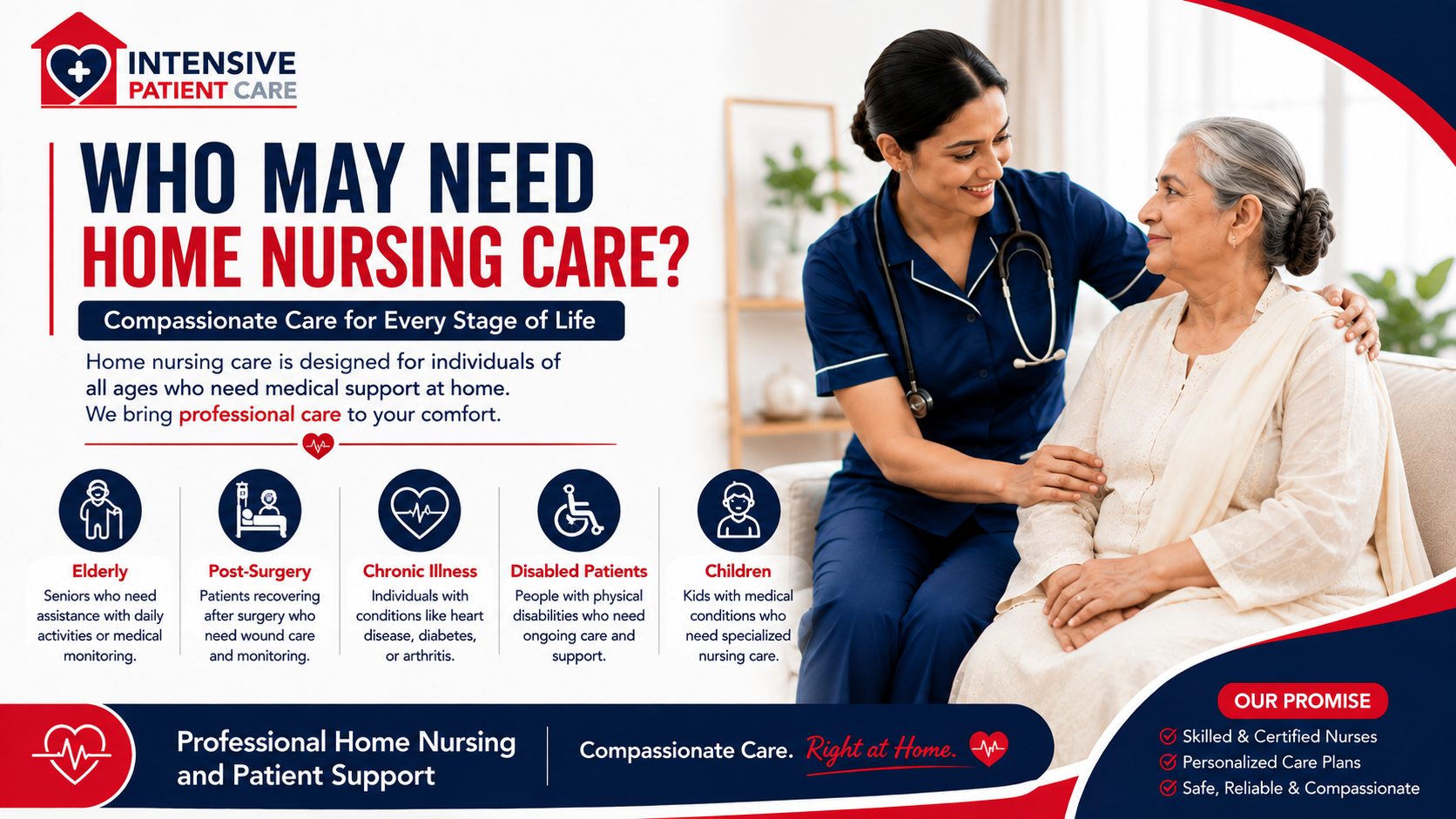
Home nursing can be helpful for patients who need regular support but are able to remain safely at home.
A healthcare professional should assess the patient’s condition before deciding whether home care is suitable.
Common examples include:
- Elderly patients who need regular assistance and monitoring
- People recovering after surgery or hospitalization
- Patients with limited mobility
- Individuals requiring wound or dressing care
- People living with chronic health conditions
- Patients who need support following a doctor’s care plan
- Individuals recovering from injuries or illness
- Patients who require assistance with personal care during recovery
Home nursing requirements can change as a patient’s condition improves or becomes more complex.
Families should regularly review the care plan when there are significant changes in health.
What Does a Professional Home Nurse Do?
A Professional Home Nurse may perform different nursing responsibilities depending on the patient’s needs, professional qualifications, and medical instructions.
Health Monitoring
Regular monitoring can help families and healthcare professionals notice changes in a patient’s condition.
Depending on the care plan, a nurse may monitor:
- Blood pressure
- Body temperature
- Pulse rate
- Blood glucose when required
- Oxygen saturation when clinically appropriate
- General symptoms and changes in health
The nurse should record relevant observations and communicate significant changes to the responsible healthcare professional.
Wound and Dressing Care
Some patients require regular dressing changes after surgery, an injury, or because of a wound that needs ongoing care.
A nurse may provide appropriate wound care according to professional instructions and observe the area for concerning changes such as increasing redness, swelling, unusual discharge, worsening pain, or other signs that require medical review.
Post Surgical Home Care
Patients may continue to need assistance after leaving the hospital. Skilled Nursing at Home can support recovery when home care is considered medically appropriate.
Depending on the procedure and doctor’s instructions, nursing support may involve monitoring, dressing care, mobility assistance, hygiene support, and observation for possible complications.
Patients should follow the instructions provided by their treating healthcare team rather than relying on general online information.
Elderly Patient Care
Older adults may need assistance with mobility, hygiene, nutrition, medication routines, and regular health observation.
A home nurse can provide professional support while family members remain involved in the patient’s daily care and medical decisions.
Home nursing can be particularly useful when an elderly person has difficulty travelling frequently to a clinic or hospital.
Support for Chronic Conditions
Patients with long-term health conditions may require regular monitoring and support.
Home nursing can help implement a care plan developed by the patient’s healthcare team.
For example, a patient may require regular health measurements, assistance with prescribed care routines, or observation for changes that should be reported to a doctor.
A nurse does not replace a doctor. Nursing care and medical care should work together when the patient’s condition requires both.
Home Nursing Care Services vs General Home Care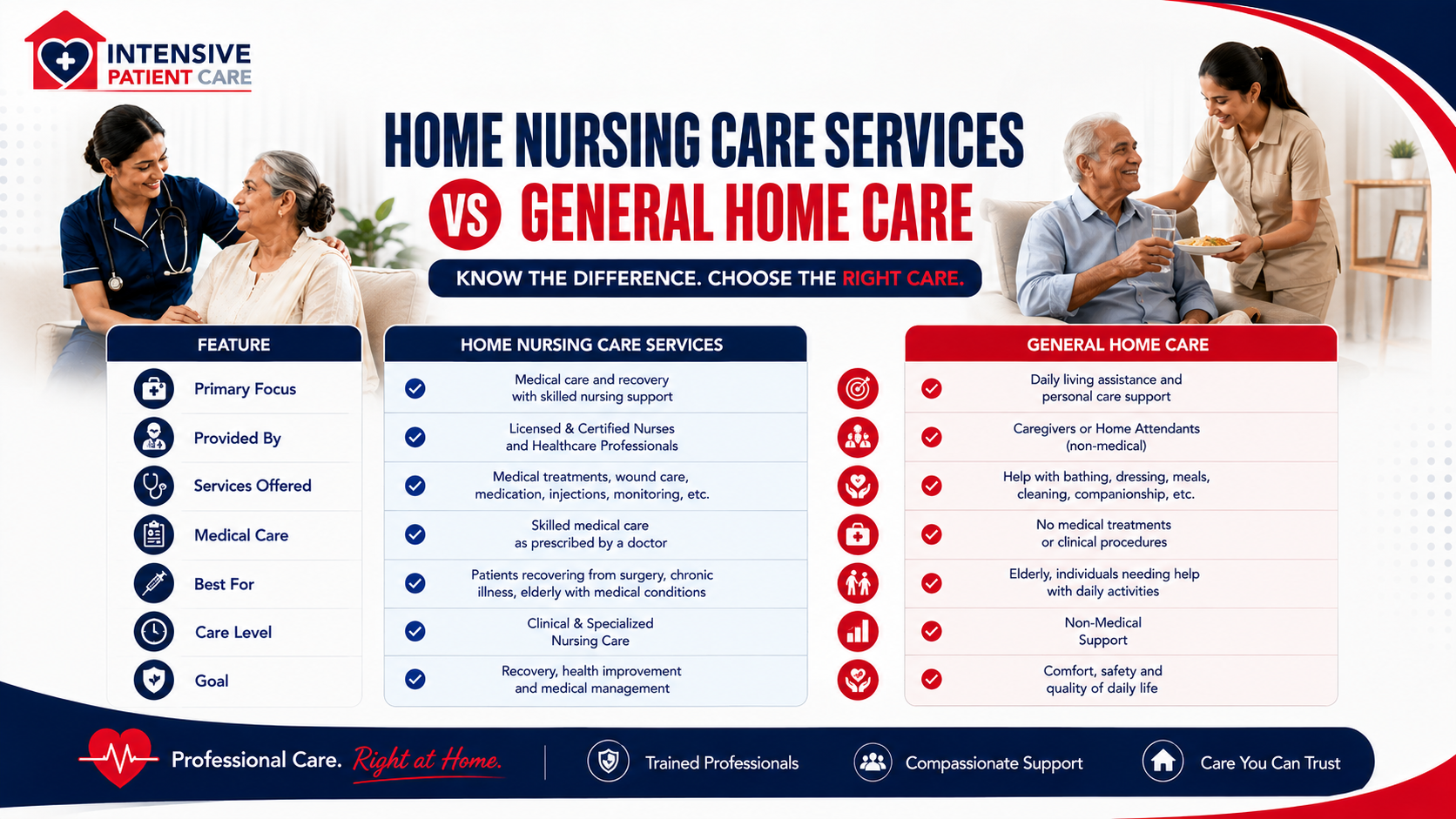
Not every patient who needs help at home requires skilled nursing. Understanding the difference can help families choose an appropriate service.
|
Type of Care |
Main Purpose |
Examples |
Suitable For |
|
General Home Care |
Daily living assistance |
Hygiene, meals, mobility support |
People needing routine help |
|
Home Nursing |
Professional nursing support |
Monitoring, wound care, nursing procedures |
Patients with medical needs |
|
Skilled Nursing at Home |
Specialized nursing care |
Complex care under medical direction |
Patients requiring skilled support |
|
Post Surgical Care |
Recovery assistance |
Dressing, monitoring, mobility support |
Patients recovering after surgery |
|
Elderly Home Care |
Support for older adults |
Personal care and health observation |
Elderly people needing assistance |
The patient’s medical requirements should determine the appropriate service. Families should not assume that a general caregiver can perform clinical nursing duties.
What Are the Benefits of In-Home Patient Care?
In Home Patient Care allows eligible patients to receive support in a familiar environment.
This can be particularly helpful for people who have difficulty travelling because of age, mobility limitations, recovery, or ongoing health needs.
Home care may also make it easier for families to maintain a regular care routine.
A professional nurse can assist with appropriate nursing responsibilities while relatives continue to provide emotional and practical support.
Some potential advantages include:
- Care in a familiar home environment
- Reduced need for unnecessary travel
- Regular observation of the patient’s condition
- Support with prescribed nursing routines
- Assistance for elderly or mobility-limited patients
- Greater involvement of family members in daily care
These benefits depend on the patient’s condition and the quality and suitability of the care provided.
How to Choose Reliable Home Nursing Care Services in Karachi
Choosing a home nurse is an important decision because the patient’s safety and comfort are involved.
Families should evaluate the provider based on professional qualifications, services, experience, availability, and the patient’s specific needs.
Before hiring a home nurse, ask about:
- Professional qualifications and relevant training
- Experience with the patient’s particular care requirements
- Services included in the package
- Working hours and shift arrangements
- Availability of replacement staff when necessary
- Supervision and communication procedures
- Emergency escalation arrangements
- Hygiene and infection prevention practices
- Coordination with doctors or hospitals when required
It is also useful to clearly establish the nurse’s responsibilities before care begins.
This helps prevent confusion between nursing duties, personal care, and medical decision-making.
Choosing a Home Healthcare Provider
Families searching for Home Healthcare Services in Karachi may find different providers offering different levels of care.
Intensive Patient Care.com can be included among the options families review when researching home patient care services.
Before choosing any provider, verify its current services, staff qualifications, availability, care arrangements, and whether its services match the patient’s specific medical requirements.
Do not select a provider only because it appears in search results. Professional suitability and patient safety should remain the main considerations.
What Should Families Prepare Before Home Nursing Begins?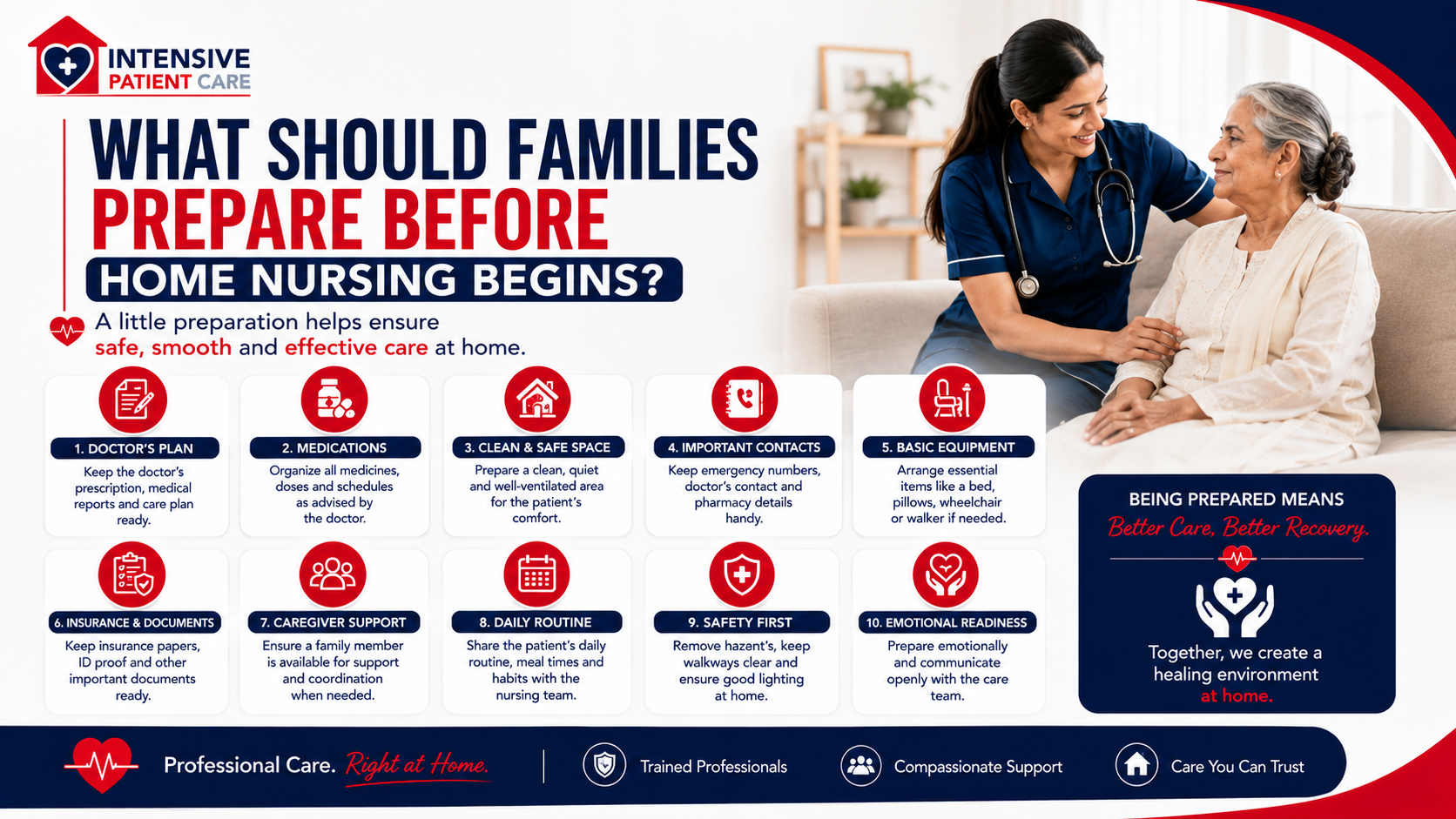
Preparing the home and the patient’s medical information can make care more organized.
Families should keep important information available, including:
- Current prescriptions
- Previous medical reports
- Relevant laboratory or imaging reports
- Known allergies
- Doctor’s instructions
- Details of previous surgeries or hospital admissions
- Emergency contact information
- Information about mobility limitations
- Important dietary or care instructions
The patient should also have a clean, reasonably accessible area where nursing procedures can be performed safely.
If medical equipment is required, families should confirm what equipment is needed and whether it is supplied by the healthcare provider or needs to be arranged separately.
How Does Home Nursing Work With a Doctor’s Care Plan?
Home nursing should generally complement medical treatment rather than replace it.
A doctor or other qualified healthcare professional may assess the patient’s condition and establish a treatment or monitoring plan.
A nurse may then provide appropriate nursing care according to that plan and report relevant changes.
For example, a patient recovering from surgery may need wound care and monitoring at home. The nurse can follow the appropriate instructions while communicating with the treating medical team.
This coordination is particularly important for patients with chronic conditions or complex healthcare needs.
When Should a Patient See a Doctor?
Home nursing does not eliminate the need for medical consultations.
A patient should receive professional medical evaluation when symptoms are new, persistent, worsening, or unexplained.
Medical review may be appropriate when a patient develops:
- Persistent or worsening pain
- Repeated vomiting
- Significant changes in blood pressure or blood glucose
- New swelling
- Persistent fever
- Worsening wound appearance
- Changes in breathing
- Significant weakness
- New confusion or unusual behavior
The specific response depends on the patient’s medical history and symptoms.
A healthcare professional can determine whether the patient needs a routine consultation, urgent assessment, or another level of care.
When Is Home Care Not Enough?
Home nursing is not suitable for every medical situation.
Some conditions require hospital evaluation, emergency treatment, diagnostic testing, or continuous medical supervision.
Families should not delay urgent medical care simply because a nurse is available at home.
Severe breathing difficulty, loss of consciousness, severe chest pain, uncontrolled bleeding, seizures, sudden weakness or paralysis, severe confusion, or rapidly worsening symptoms can require urgent medical attention.
If the patient’s condition appears immediately dangerous, seek emergency medical assistance rather than attempting to manage the situation solely through home nursing.
Common Mistakes to Avoid With Home Nursing
Families sometimes focus heavily on convenience and cost when arranging home care. However, the patient’s medical needs should come first.
Common mistakes include hiring an unqualified person for clinical nursing duties, failing to share the patient’s medical history, changing medications without professional advice, ignoring worsening symptoms, and not communicating important changes to the treating healthcare team.
Another mistake is assuming that a nurse can independently diagnose a new medical problem or change treatment without appropriate medical direction.
Clear communication between the patient, family, nurse, and healthcare professionals helps reduce these risks.
How Much Nursing Care Does a Patient Need?
There is no single schedule that works for every patient. The required hours depend on the person’s health, mobility, age, level of independence, and medical needs.
Some patients may need short daily visits for specific nursing tasks.
Others may require several hours of support each day, while patients with more complex needs may require longer shifts.
A healthcare assessment can help determine an appropriate level of care.
The schedule may also need to change as the patient’s condition improves or becomes more demanding.
Home Nursing for Elderly Patients in Karachi
Elderly patients may have several needs at the same time.
They may experience reduced mobility, difficulty managing daily routines, chronic health problems, or increased dependence on family members.
Home nursing can provide structured assistance while allowing older adults to remain in a familiar setting when medically appropriate.
Families should pay attention to changes in mobility, appetite, sleep, alertness, medication routines, and general health. Sudden changes should be communicated to a healthcare professional.
Home Nursing After Hospital Discharge
Leaving the hospital does not always mean that a patient has completely recovered. Some people need continued support during the early recovery period.
Home nursing after discharge may help with appropriate wound care, monitoring, hygiene, mobility, and other nursing responsibilities.
Before discharge, families should ask the hospital or treating doctor about follow up appointments, prescribed medicines, wound care instructions, activity restrictions, warning signs, and when to seek medical attention.
Frequently Asked Questions
What are Nursing Services at Home?
Nursing services at home provide professional nursing support to patients in their own homes.
Depending on individual needs, services may include health monitoring, wound care, post surgical support, elderly care, and assistance with an established healthcare plan.
Who can benefit from a Professional Home Nurse?
Elderly patients, people recovering from surgery, individuals with mobility limitations, patients with chronic conditions, and people who require regular nursing support may benefit from a professional home nurse. Suitability depends on the patient’s medical condition.
What is the difference between home nursing and home care?
Home nursing involves professional nursing responsibilities, while general home care may focus on daily activities such as hygiene, meals, companionship, and mobility assistance.
Patients requiring clinical care should receive support from appropriately qualified professionals.
Is Skilled Nursing at Home safe for every patient?
No. The suitability of home nursing depends on the patient’s condition, medical needs, home environment, and available professional support. Some patients require hospital care or closer medical supervision.
How can I find Home Nursing Care Services in Karachi?
Compare providers based on staff qualifications, experience, services, availability, hygiene practices, supervision, emergency procedures, and the patient’s specific requirements. Verify current information directly with the provider before starting care.
Can home nursing replace a doctor’s consultation?
No. A nurse can provide appropriate nursing care within their professional scope, but medical diagnosis, treatment decisions, and changes to prescribed medication generally require appropriate medical evaluation.
How long does a home nurse stay with a patient?
The schedule depends on the patient’s condition and care requirements. Some patients need brief visits, while others may require several hours or longer shifts. A professional assessment can help determine the appropriate schedule.
When should home nursing patients seek urgent care?
Urgent medical assessment may be necessary for severe breathing difficulty, loss of consciousness, severe chest pain, uncontrolled bleeding, seizures, sudden paralysis or weakness, severe confusion, or rapidly worsening symptoms.
Conclusion
Reliable Nursing Services at Home can help patients receive professional support while staying in a familiar environment.
Home nursing may be useful for elderly patients, people recovering after surgery, individuals with limited mobility, and patients who need ongoing nursing assistance.
The right type of care depends on the patient’s medical condition. Home Nursing Care Services should be provided by appropriately qualified professionals and should complement medical evaluation and follow-up when required.
Families in Karachi should carefully evaluate the qualifications, experience, responsibilities, availability, and care standards of any provider before making a decision.
Services such as intensivepatientcare.com can be considered during the research process, but current service details and suitability should always be verified directly.
Most importantly, home nursing should never delay urgent medical treatment.
When a patient’s condition changes suddenly or serious warning signs appear, appropriate medical or emergency care should be sought promptly.